
A few crimson threads can transform an entire dish, but only when their aroma, color, and flavor have a chance to open. Learning how to grind saffron is a small kitchen skill with a remarkable payoff: richer golden color, a fuller floral fragrance, and more even flavor in every spoonful.
With premium Super Negin saffron from Herat, a little goes a long way. The threads are naturally potent, handpicked, and deeply aromatic. Treat them gently, grind only what you need, and bloom the powder before it reaches your recipe. That is how the Gold of Afghanistan earns its place at the table.
Saffron threads contain the compounds responsible for their signature color, aroma, and subtle honeyed, earthy taste. Whole threads release these qualities slowly. Grinding breaks the threads into a fine powder, increasing their surface area so they infuse more completely into a small amount of liquid.
This matters most in dishes where saffron needs to spread evenly: Persian rice, paella, risotto, custards, cakes, syrups, saffron tea, and milk-based desserts. A few whole threads scattered directly into a pot may leave one bite intensely flavored and another nearly untouched. A properly bloomed saffron infusion gives you a more consistent result.
Grinding is not mandatory for every use. If you are steeping threads in a teapot or finishing a dish for visual appeal, whole threads work beautifully. But when you want maximum color and aroma from a small quantity, grinding is the better method.
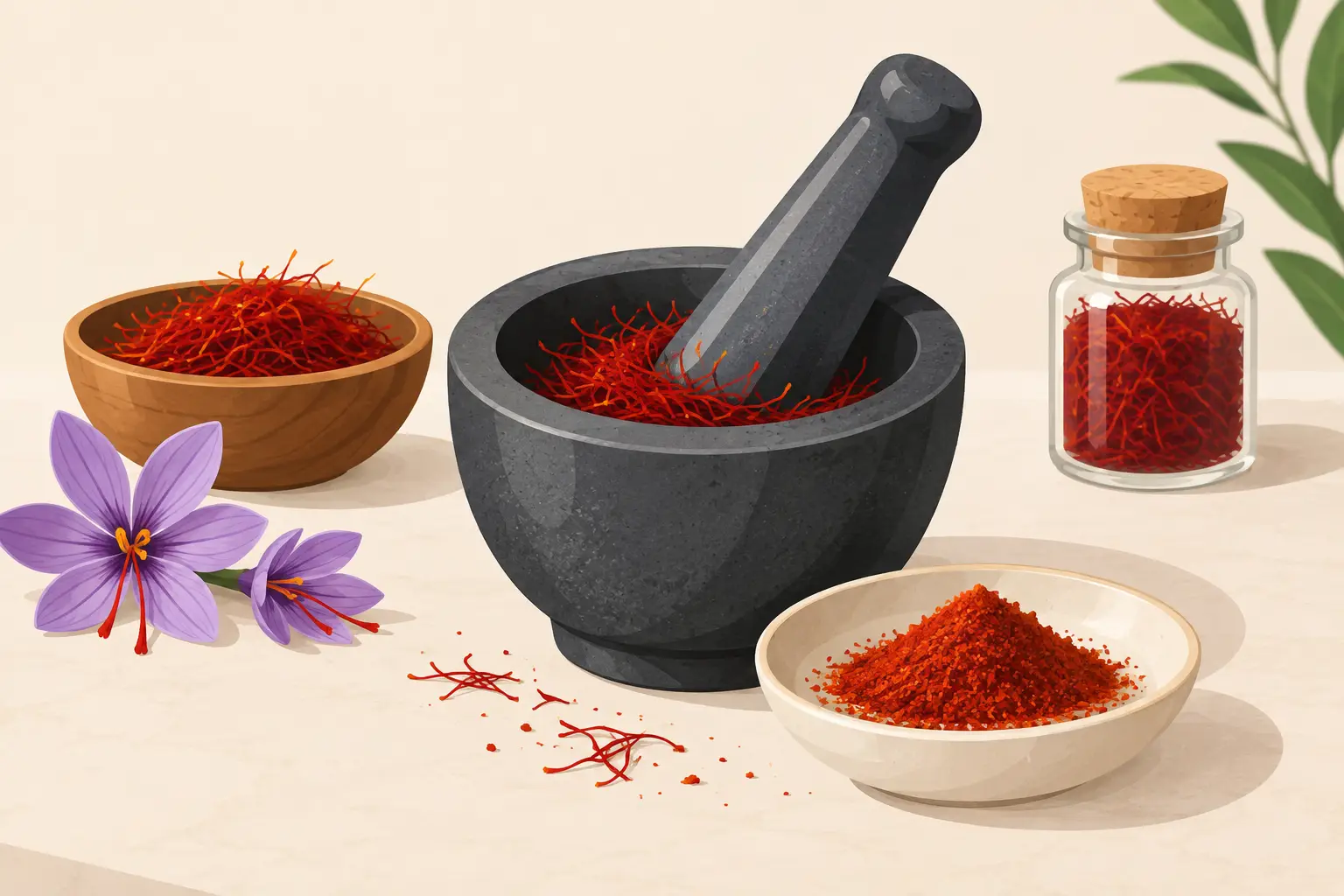
The best tool is a small mortar and pestle. Stone, ceramic, glass, or stainless steel works well. Choose one that is completely clean and dry, with no lingering smell from garlic, cumin, coffee, or other strong ingredients. Saffron is delicate, and it can absorb unwanted aromas.
If you do not have a mortar and pestle, place the threads between two sheets of parchment paper and press them with the back of a spoon. You can also use a small spice grinder, but only if it is dedicated to clean, dry spices. A large grinder can waste precious saffron by leaving powder trapped around the blade and sides.
Avoid grinding saffron with wet tools. Moisture can cause the threads to clump, and it shortens their quality during storage.
Start with the quantity your recipe calls for. For many home dishes serving four to six people, 10 to 20 high-quality threads are enough. Because Super Negin saffron is long, red, and highly potent, the exact amount depends on the dish, the volume of food, and how pronounced you want the saffron character to be.
Place the threads in your dry mortar. Add a very small pinch of granulated sugar or a few grains of salt if desired. This is a traditional and practical technique, not a requirement. The crystals create gentle friction that helps the threads break down into a fine powder. Sugar is especially suitable for desserts and tea; salt can work well for savory dishes. Use so little that it will not affect the recipe.
Press and rotate the pestle with a light, steady motion. Do not pound aggressively. In less than a minute, the threads should become a soft red-orange powder. There may be a few tiny flecks left behind, which is perfectly fine.
Transfer the powder immediately to a small cup or bowl for blooming. Do not leave it exposed on the counter. Its volatile aroma is one of saffron’s greatest qualities, and it deserves protection.
Fine saffron powder will look red to orange-red, not bright yellow. The yellow-gold color emerges after blooming. If powdered saffron looks overwhelmingly yellow before steeping, it may contain excess yellow style material or other fillers. Pure saffron should begin with predominantly red threads and deliver its golden color gradually in liquid.
Grinding is only half the process. Blooming is where saffron begins to express itself.
Add 1 to 2 tablespoons of warm water, warm milk, warm broth, or ice cubes to the ground saffron. For warm liquid, aim for hot but not boiling. Boiling water can flatten the aroma and make the flavor feel less refined. Let the mixture rest for at least 15 to 20 minutes. Thirty minutes is even better when time allows.
The ice method is popular in Persian cooking. Place the ground saffron in a small bowl, add one or two ice cubes, and let them melt naturally. This slow extraction produces a deeply colored infusion with a delicate perfume. It takes longer, but it is ideal when saffron is the center of the dish.
Once bloomed, add the infusion near the end of cooking when possible. Long, hard boiling can mute saffron’s aroma. For rice, drizzle the infusion over a portion of cooked rice reserved for the golden top layer. For risotto or sauces, stir it in during the final minutes. For baking, add it to the recipe’s wet ingredients after blooming.
Water is versatile and lets saffron’s pure character shine. Use it for rice, soups, stews, seafood, and syrups. Milk or cream is excellent for custard, ice cream, rice pudding, and cakes because the richness carries saffron’s floral notes beautifully.
Broth works for savory dishes, though it should be mild enough that saffron is not lost behind heavy flavors. If you are making saffron tea, bloom the ground threads in a small amount of hot water first, then dilute with more water to your preferred strength. Cardamom, honey, and dried rose can be lovely companions, but use them with restraint.
It depends on the recipe, but alcohol is usually not the first choice for blooming. It can pull out flavor, yet it may introduce a sharper note than you want. Water, milk, and ice remain the most reliable methods.
The most common mistake is using too much. Saffron is not meant to hit the palate like chili or garlic. Its flavor should feel fragrant, warm, and lingering. Too much can taste medicinal or bitter, especially in delicate desserts.
Another mistake is adding dry threads straight into a large pot and expecting immediate color. The threads will still contribute something, but you will not get the same even intensity as you would from a ground, bloomed infusion.
Do not toast saffron aggressively in a hot pan. Some cooks warm threads very briefly to remove excess moisture, but this is unnecessary for well-stored saffron and easy to overdo. Heat can quickly drive off the aromas you paid for.
Finally, do not grind a large batch for later. Whole threads protect saffron’s natural oils better than powder. Grind just before blooming, then return the remaining threads to proper storage.
Keep whole saffron threads in an airtight glass container, away from heat, direct light, and humidity. A cool, dark cabinet is usually ideal. Avoid keeping saffron beside the stove, where steam and temperature changes can weaken it over time.
Do not refrigerate saffron unless your kitchen is unusually hot and humid, since condensation can be a concern each time the container is opened. If you do refrigerate it, make sure the container is tightly sealed and allow it to come to room temperature before opening.
Fresh, high-quality saffron should smell sweet, floral, and hay-like, with a clean earthy depth. It should never smell stale, dusty, or chemical. Farmers Saffron’s Afghan Super Negin threads are selected for this vivid red color and naturally rich aroma, from Herat’s fields to your kitchen.
Leave threads whole when presentation matters. A few red strands on a saffron bun, a festive rice platter, or a cup of tea signal care and authenticity. Whole threads are also easier to identify, which gives home cooks confidence that they are using pure saffron rather than anonymous powder.
For slow infusions, such as a simple pot of tea, you can steep whole threads directly. Crush them lightly between your fingers first if you want a faster release. Still, for recipes where every thread must work hard, grinding and blooming remain the clearest path to color and flavor.
The next time you reach for saffron, pause before adding it to the pot. Grind a few threads, give them time to bloom, and let their golden infusion carry the story of Herat into the dish you are making.